

DR. CRANE BREAKS HIS SILENCE: “THIS IS NOT A BRAINWASHING MACHINE”
ALGOR MOUNTAIN — After days of speculation surrounding Lieutenant Katscher’s hospitalization and the existence of a mysterious so-called “tube machine,” Dr. Crane has finally decided to publicly address questions concerning Carlisne’s private clinic in Algor Mountain.
According to the physician, the reality is far less sinister — and, paradoxically, technologically far more advanced — than the theories currently circulating.
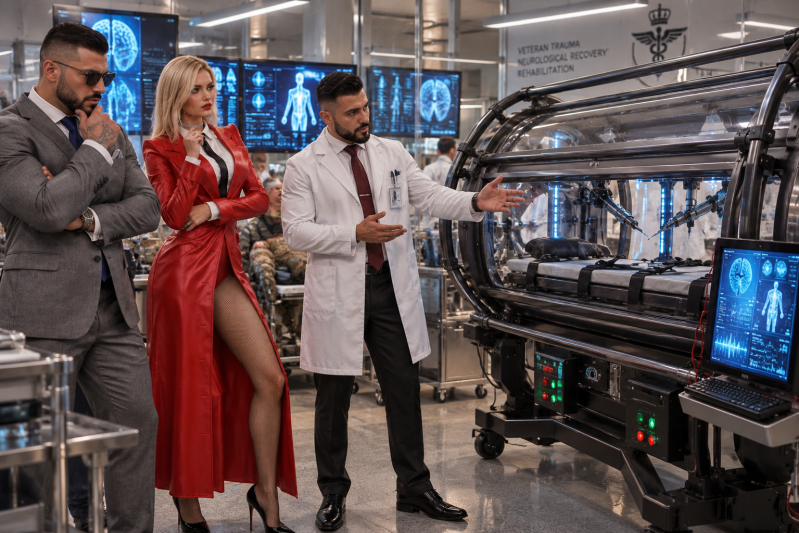
Crane confirms that the clinic does indeed possess a highly sophisticated piece of medical equipment that could reasonably correspond to the description of the alleged “tube machine.”
But he categorically rejects the suggestion that the device was designed to “reprogram” a human brain.
According to Crane, it is a medical technology developed several years ago in the Principality of Carlisne for the treatment of particularly severe trauma.
A TECHNOLOGY DEVELOPED FOR VETERANS
Dr. Crane explains that the device was originally developed for veterans of the Principality’s armed forces suffering from severe post-traumatic stress.
Its general purpose, he says, is to allow physicians to temporarily modulate activity in certain regions and neural circuits associated with traumatic responses or particular forms of pain.
The objective is therefore not to erase memories, much less to “reprogram” a patient’s personality.
Rather, the technology is intended to temporarily reduce certain neurological responses, allowing a patient to pass through a critical phase of treatment or rehabilitation under better conditions.
Crane says the technology has been used for several years in specialized facilities treating severely wounded military personnel, as well as in medical units caring for major burn victims.
According to him, the system has been clinically proven and in use for approximately five years.

“SHIM’S REFUSAL DID NOT PROTECT THE PATIENT”
Crane confirms that he wanted Katscher transferred to the Carlisne clinic.
But while Detective Shim has portrayed his refusal as a precaution intended to keep the lieutenant in a conventional hospital where there would be more “eyes and ears,” Crane offers a radically different interpretation.
According to the physician, Shim did not protect Katscher — he denied a patient rapid access to specialized medical care.
The distinction, Crane argues, is important.
He says the proposed transfer was not motivated by political, diplomatic or police considerations, but by Katscher’s clinical condition.
Given the substances reportedly found in her system, her memory problems and the severe trauma she had endured, Crane believed the technology available at the clinic could help reduce certain post-traumatic responses and potentially accelerate her recovery.
The transfer would also have placed her in a medical unit staffed by personnel specifically trained to use the technology.
Shim refused.
And for Crane, that is precisely where the real problem begins.
The decision may indeed have prevented something, Crane suggests:
the patient’s faster recovery.

WHY HAS NO ONE HEARD OF IT?
Dr. Crane readily acknowledges that the technology remains virtually unknown outside the Principality.
For much of its development, the program was reportedly classified under Carlsine national-security regulations, largely because its earliest applications involved members of the armed forces.
That classification has since been partially lifted.
However, even after five years of clinical use, Carlsine has still not authorized the device for commercial export.
That, Crane argues, explains why the technology remains largely unknown to the American medical community — and why its presence inside an Algor Mountain clinic may now appear so unusual.
WHY IS THIS EQUIPMENT IN ALGOR MOUNTAIN?
Crane says the answer is directly connected to Carlsine’s diplomatic presence.
The clinic is intended, among other purposes, to provide rapid medical treatment to embassy personnel and official representatives of the Principality in the event of a serious medical emergency.
But another reason reportedly explains the presence of such unusually advanced equipment.
That reason has a codename:
SPHYNX.
It is the codename used by the protective services for the Chancellor of Carlsine during certain official movements and visits.
The Sphynx’s travels are reportedly accompanied by specialized medical capabilities designed to provide immediate intervention in the event of an attack, accident or catastrophic injury.
Certain medical facilities associated with Carlsine’s diplomatic missions therefore maintain advanced stabilization and reconstructive technologies, allowing physicians to intervene without waiting for an emergency evacuation back to the Principality.
The Algor Mountain clinic is said to be one of those facilities.
According to Crane, the presence of the device in the United States therefore has no particular connection to Katscher.
THE “TUBE MACHINE”: A HOSPITAL CONVERSATION, NOT A MEMORY FROM CAPTIVITY
This is where Crane offers a clarification that could significantly alter the interpretation of the case.
According to his account of events, discussions concerning the technology and the possibility of using it to treat Katscher occurred after her rescue, while she was hospitalized — not during her captivity.
In other words, hearing Crane’s name or overhearing physicians and others discussing a possible transfer to a clinic equipped with advanced neurological technology would not, in itself, have been mysterious.
The lieutenant was in a medically complex condition, under treatment and suffering from fragmented memories.
For Crane, transforming those hospital conversations into evidence of a clandestine “reprogramming” project is therefore an extremely questionable interpretation.
And it is on this point that the physician becomes considerably less diplomatic.
“SINCE WHEN DOES A DETECTIVE DECIDE A PATIENT’S TREATMENT?”
The physician makes little effort to conceal his irritation over the way the decision is now being portrayed.
What appears to anger Crane most is not simply that Shim opposed the transfer, but that someone who, according to Crane, possesses no medical qualifications effectively intervened in a decision concerning the treatment strategy of a severely traumatized patient.
Crane believes the question should therefore be asked in reverse.
If Katscher could have benefited from specialized treatment capable of accelerating her recovery, on what medical basis did Shim decide that she should not have access to it?
The detective may have had legitimate concerns regarding Katscher’s security or the preservation of potential evidence.
But Crane argues that police concerns do not, by themselves, constitute neurological expertise.
From his perspective, portraying Shim’s refusal today as a decision that may have “prevented something from happening” turns the situation entirely on its head.
A CONFLICT BETWEEN POLICE LOGIC AND MEDICAL LOGIC
The controversy therefore reveals a conflict extending well beyond the question of a mysterious machine.
Shim thinks like an investigator.
He wants to control the victim’s environment, know who has access to her and prevent anyone potentially connected to the case from approaching her.
Crane thinks like a physician.
He believes that a patient suffering from severe neurological and psychological trauma should have access to whatever specialized treatment her medical condition warrants.
Both positions may be understandable.
But Crane believes a line was crossed when police caution began determining which medical treatments Katscher could or could not receive.
And the physician appears particularly frustrated that this same decision is now being used to fuel suspicions against the clinic.
MKULTRA: “WE HAVE GONE FROM MEDICINE TO SCIENCE FICTION”
The comparison with MKULTRA has also drawn a sharp response from Crane.
According to the physician, the theory appears to rest largely on a dramatic chain of associations: a technology capable of temporarily affecting certain brain responses exists; it is little known outside Carlsine; it was classified for years; and one such device happens to be located inside a clinic connected to the Principality.
From there, Crane argues, some have jumped directly to the idea of mind-control technology.
But, he insists, temporarily modulating a traumatic neurological response is not the same thing as rewriting a human brain.
The device cannot implant memories, selectively erase a person’s past, or rewrite someone’s personality or beliefs, according to Crane.
It is, he insists, a therapeutic tool.
More importantly, under Crane’s version of events, discussions about potentially using the technology to treat Katscher were not mysterious recollections from her captivity.
They were simply discussions of a possible treatment after she had already arrived at the hospital.
ONE QUESTION REMAINS
Crane’s response does not, of course, resolve the broader case.
It does not identify those responsible for Katscher’s alleged abduction.
Nor does it explain the unidentified third substance reportedly discovered during toxicology testing.
And by itself, it cannot determine which interpretation of the events at the hospital is correct.
But Crane’s response substantially shifts the debate.
Perhaps the question is no longer:
“Why did Crane want Katscher taken to a clinic containing a mysterious machine?”
Perhaps it should instead be:
“Why was a proposed specialized medical treatment interpreted as possible evidence of a mind-control operation?”
And a second, considerably more uncomfortable question for Shim may eventually have to be addressed:
In attempting to protect a witness, did the detective overstep his role and unintentionally delay a patient’s recovery?
On that question, neither speculation about MKULTRA nor Dr. Crane’s own statements can provide a definitive answer.
The answer would have to come from Katscher’s medical records, the physicians who actually treated her, and a precise timeline of the decisions made during her hospitalization.
Add comment
Comments